Do you really need a CTO?
Lovable splashed "You Don't Need a CTO" across Times Square. A bold, perhaps misleading, claim. They're selling a vision.
But let's cut through the noise: Does your startup truly need a technical co-founder? The answer isn't simple. Spoiler: Yes, eventually. But the "when" and "how" are the real leverage points.
We'll unpack the stages where technical leadership becomes not just useful, but indispensable.
The Traditional View: Two Founders
Classically, in the startup world, it's often said that you need two founders for a startup: one responsible for the business side, who will sell what your application or startup does, and a second technical person, a CTO or technical co-founder, who will be responsible for product development. This advice, for example, is given by Y Combinator, a VC fund that also offers mentoring for startups in California.
And this advice is generally sound. If someone has an idea but doesn't know how to implement it, they need to complement their skills, for instance, by finding a co-founder who understands how to build technology.
Tech ecosystem evolves
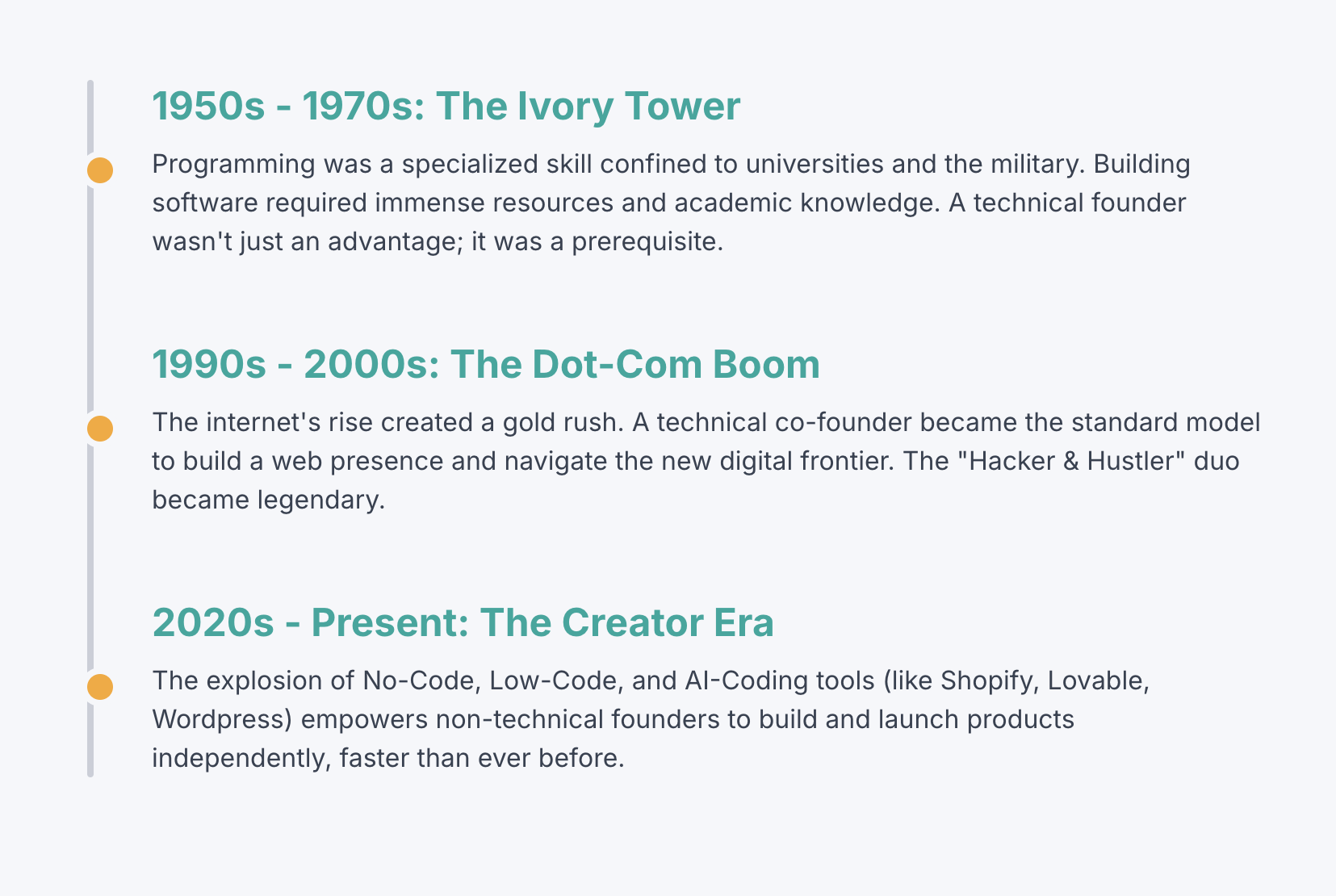
However, it's 2025, and technology is simpler to use. For example, in the 1950s, to program, you had to be at a university or in the military. Later, programming became more widespread, entering the business world. In the 1960s and 70s, the first computers, perhaps not everywhere, but in the US, started appearing in offices.
Then came the 1990s and early 2000s, with the dot-com bubble, when tech companies wanted to go online, went online, and made good money doing so. This is when the need arose to bring a technical co-founder into your startup or company—someone who could handle the technological side.
If we think about the 2000s to 2010s, at that stage, you needed a programmer to create a website or set up an online store. But let's look at how it is today. We already have WordPress, which has been around for some time. We have platforms like Shopify. Tech is becoming simpler to use, and you don't always need a programmer to create an application that supports your business.
Now, we have more and more no-code and low-code tools that support the creation of applications that are simply useful for us. No-code applications aren't new; creating applications in this no-code/low-code style has been around. It's just that there are more of these tools now, and on top of that, we now have AI coding.
The Pitfalls of No-Code and AI Coding Without Technical Oversight
Okay, let's assume you've already created a solution using these no-code platforms. How do you know what mistakes might have been made? If you don't have a technical background, you probably aren't even aware of the limitations of these tools.
These limitations can include:
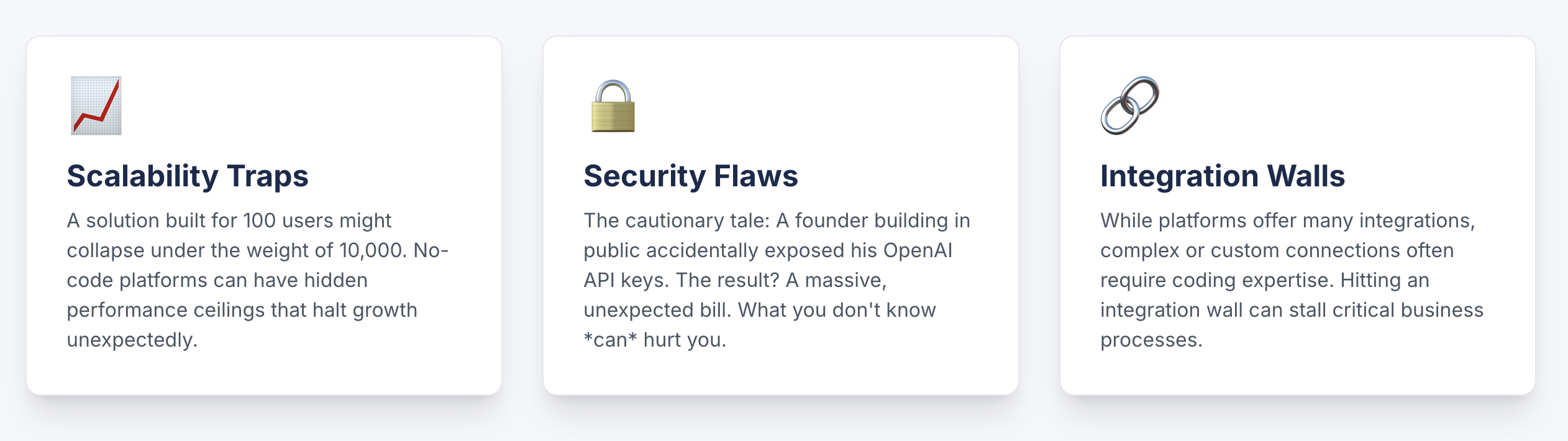
- Scalability: Will your solution handle a surge of users? Will it behave the same way with 10,000 users as it does with a million? (This isn't a problem you need to solve right now; I sincerely wish you a million users!)
- Integrations: Can your application integrate seamlessly with other tools? While platforms like make.com or n8n offer many integrations, sometimes you need something more custom, more specific. If you don't have a technical background, you probably can't easily build this, even with AI coding.
Furthermore, if you're truly doing "vibe-coding" and having some success, you might make mistakes whose consequences you can't even predict.
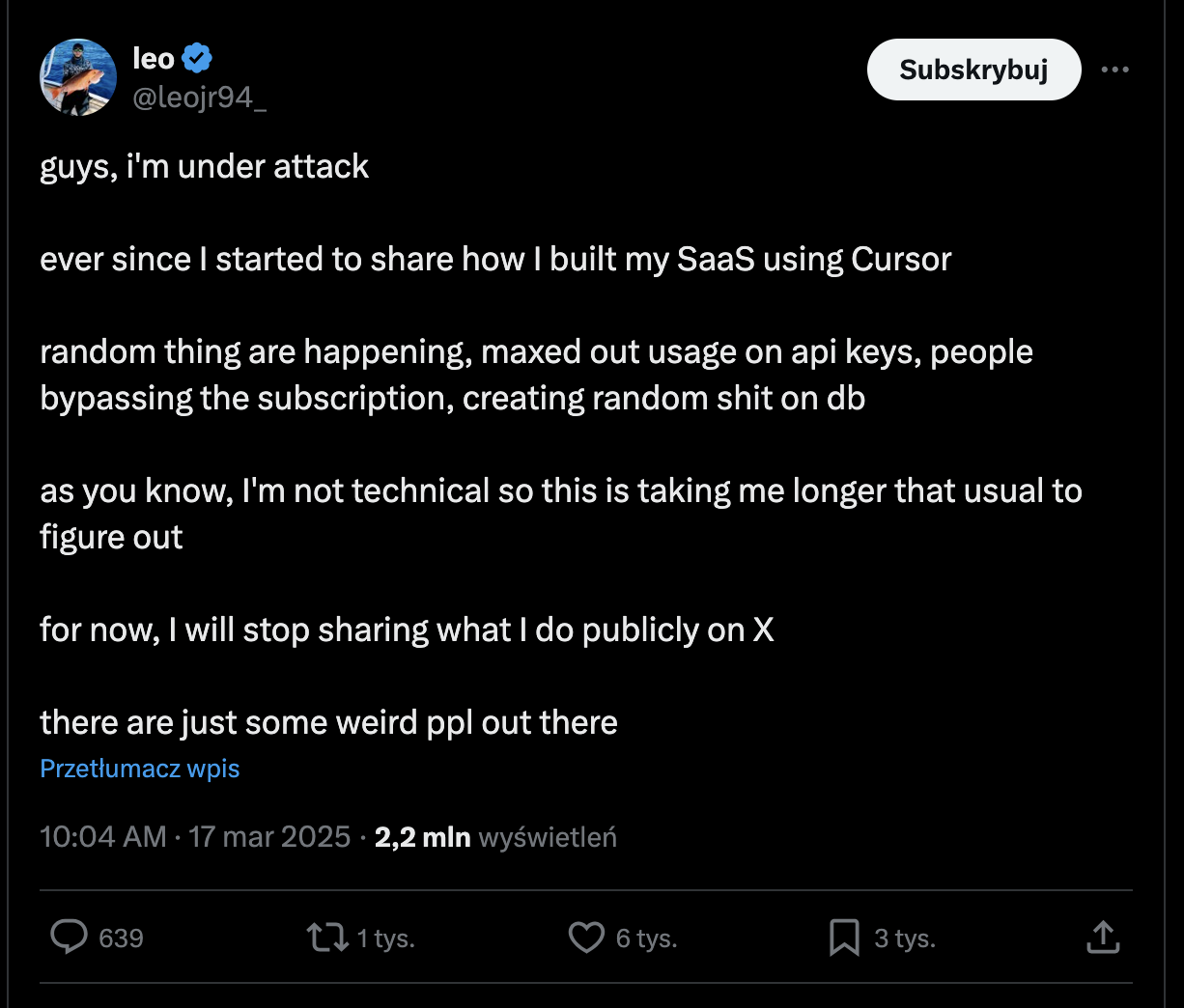
There was a guy on Twitter who decided to "build in public," sharing his application's development in real-time. This person had no technical background. He described his progress on Twitter and even posted a public URL to his app.
What happened? He didn't properly hide or secure the API keys he was using for OpenAI. Twitter users, being the pranksters they are, started spamming his application, and he ended up with a very large API bill to pay. You don't want to find yourself in that situation.
So, you need to build responsibly. If you have a technical background, you probably already know what the limitations might be. If you don't, the simplest method is to ask a programmer friend. I bet you have someone like that in your network. Ask a programmer what exactly needs to be done here, or if there are any silly mistakes. By the way, if you'd like my team to review your application, please get in touch.
When Do You Not Need a CTO?
Let's return to the initial question: Do you need a CTO or a technical co-founder? We'll use these terms interchangeably here.
First, I'll tell you when you don't need a technical co-founder, and it's straightforward:
- When your product isn't technological.
- When you exclusively use off-the-shelf solutions.
- When you're not selling software or a highly innovative service that requires custom software creation.
If you don't need custom software, you don't need a CTO. Such a person might be useful, but you don't need them full-time. So, in this situation, it's simple.
When Do You Need a CTO? The Three Stages of a Tech Product
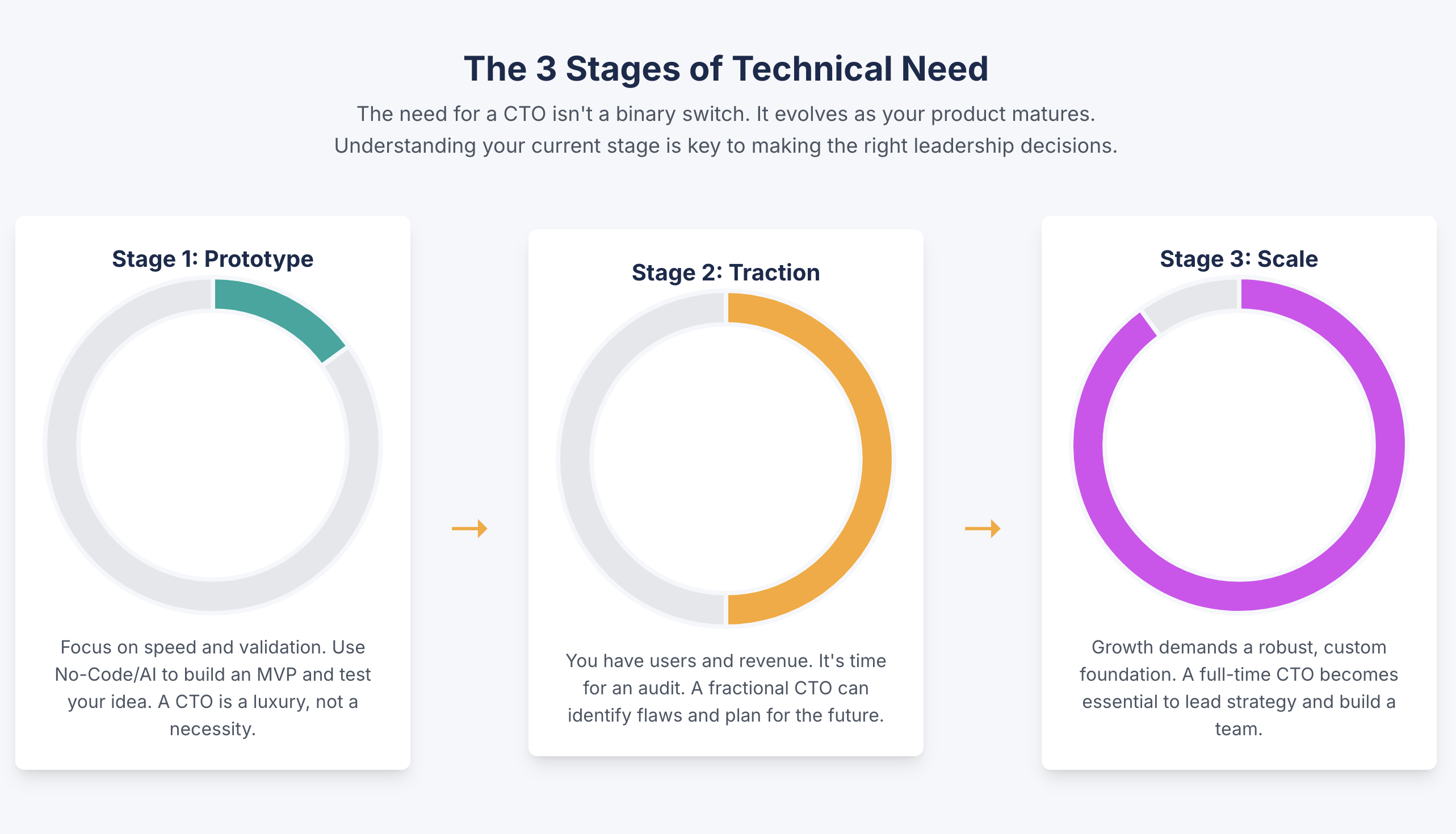
Now, let's assume you are building a technological product. Here, we'll distinguish three stages and discuss at which stage and in what form you might need a CTO. These stages are:
- Prototype Creation
- Traction (when you have clients and start earning something)
- Scaling your business
Let's discuss these stages now.
Stage 1: Prototype Creation (Experimentation)
The first stage of any technical venture is, of course, experimentation: creating a prototype, MVP, whatever you want to call it. It's about creating a minimal version of your product that allows you to check if it even makes sense.
At this stage, you can absolutely use low-code tools, leverage automation, and even create a prototype yourself using AI Coding and Vibe Coding. There are tons of great resources on how to get started. You can also use my e-book, the link to which will be in the description of this episode.
In any case, at this stage, your goal is to validate your idea and gather your first users. Can you create this prototype using automation? Yes. Can you create a simple waitlist? Yes. Can you build a basic application with AI Coding? Yes. Get a few users and validate your business idea.
Do you need a CTO at this stage? No, you don't. But they might be useful if you don't feel comfortable with no-code tools and AI Coding. A CTO you invite to such a project at this stage probably won't be writing custom code; they'll also use these types of tools to get things done faster. Remember, this is the experimentation phase; the goal is to validate our idea and acquire our first users.
Stage 2: Traction (Validation & Initial Growth)
Okay, let's assume your experiment was successful. Successful enough that you decide, "Alright, let's move forward with this." You already have a few users, and maybe your application is even starting to generate revenue.
At this point, you still don't necessarily need a full-time CTO, but you definitely need an audit of your solution. Why an audit? Because along the way, you've probably made some mistakes that will be immediately obvious to a professional programmer or a professional CTO, but you might not catch them. So, once you have your first users and money starts flowing into the application, it's essential to invest in this type of audit. It will be beneficial.
This is the traction phase. You can now consider hiring a part-time CTO, a so-called fractional CTO. This is someone who will not only be a programmer in the project but also a strategist. Someone who will help optimize the costs of what's happening on those no-code platforms. Someone who might already be able to create a better solution using custom code.
Stage 3: Scaling (Growth & Optimization)
The next stage here will be scaling. And beware: most startups don't reach this stage. Scaling means doing things that support the sensible growth of your business. At this stage, no-code and low-code tools probably start to become insufficient. It might happen that their use is perfectly fine, but it's always worth doing an audit and asking whether these tools are sufficient, or if at this stage, it's better to invest in custom code that will create the same solutions, simply cheaper and in a more optimal way.
You already have clients and money from this application, so transitioning to custom code seems reasonable. And at this stage, you need a CTO not to create the project or write software, but more in the vision of a strategist. Someone who will help create the technical infrastructure for the project. Someone who will build the technical team for the project.
So, at this stage, it's worth having a trusted person—it could be a technical co-founder, a "late co-founder" (someone who joined the project later). It's worth having such a person to handle the technical part. If you are the business co-founder, you focus on sales, while your technical co-founder focuses on the development of the product itself and the platform your clients use.
Summary of Stages
To summarize these stages:
- Initial Stage (Prototype Creation): Do you need a technical co-founder? No, if you can do it yourself using AI Coding and No-Code, that's great. They might be useful if you don't want to do these kinds of things yourself. A technical co-founder will probably also use No-Code and AI Coding here. So, first stage, prototype creation: you don't need a CTO, you don't need a programmer, but they can be helpful.
- Traction Stage: Here, it's good to have a technical person who can advise you on what has been done in the project and why it was done that way. You need someone to conduct a kind of audit. If your product is highly technical, at this stage, it's worth transitioning to Custom Code and having a CTO or technical co-founder, at least part-time.
- Scaling Stage: Finally, we have the scaling phase, where your application is growing, and your user base is also growing. Here, it's definitely worth having a dedicated person who will be responsible for your project's infrastructure, the entire technical part, and someone who can build a technical team.
Final Thoughts and Next Steps
I encourage you to look for a technical co-founder at every stage of your project. It's always worth having a technically savvy person in your network.
And if you need support right now with your AI-coded project or your no-code prototype, reach out to us at Let's Work Together. You'll find a link to a free consultation. We'll evaluate your app and suggest further steps. This consultation will always be substantive, and you'll receive a clear summary afterward, so you'll know what to do next with your project.